
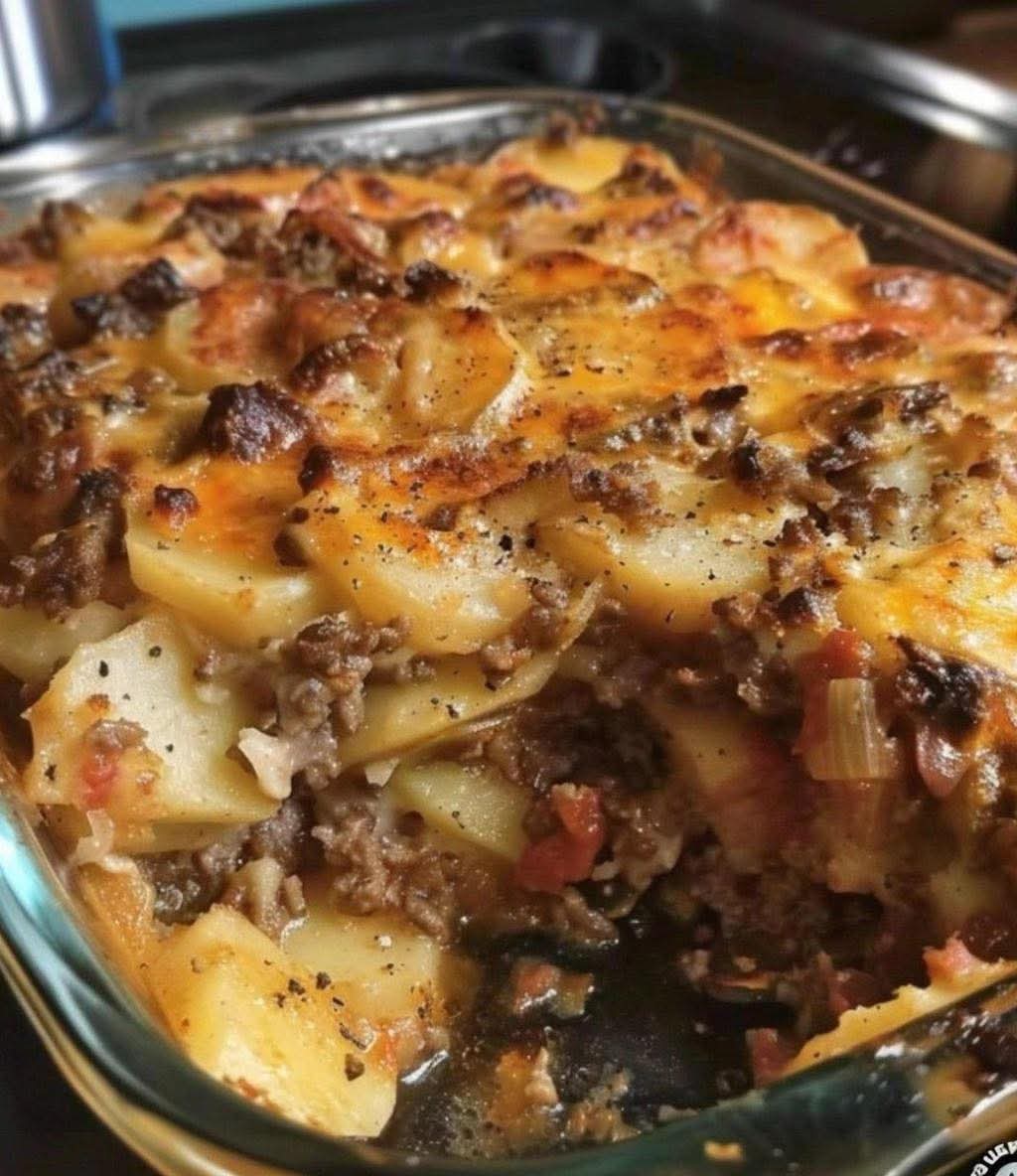
Cheesy Hamburger Potato Casserole — Hearty, Cheesy & Utterly Comforting
Cheesy Hamburger Potato Casserole is the ultimate weeknight comfort food: thinly sliced potatoes layered with savory browned ground beef, a creamy cheddar sauce, and a blanket of molten cheese. This dish combines convenience, forgiving technique, and deeply satisfying flavors into a single 9×13 pan that feeds a family and delivers warm, nostalgic satisfaction. Whether you need a make-ahead dinner, a potluck contribution, or a cozy meal to serve on a chilly night, this casserole checks every box.
Below is a comprehensive, expansive guide written in a clear, practical style: complete ingredient science, precise step-by-step instructions, timing and workflow strategies, troubleshooting, flavor variations, presentation and serving ideas, make-ahead and freezer advice, nutrition notes, and a printable recipe card. This is the only recipe you’ll need for a perfect cheesy hamburger potato casserole every time.
What makes this casserole so good — a quick overview
The magic of this casserole comes from three harmonious elements working together:
- Potatoes: thin, even slices cook through and soak up the sauce, giving creamy texture without becoming mushy.
- Umami-rich browned ground beef: adds savory depth and textural contrast.
- Cheesy, creamy sauce: binds the layers, keeps the potatoes tender, and delivers gooey, melty satisfaction.
It’s a forgiving formula: swap spices, change the cheese, or use leftover mashed potatoes if needed — the structure remains the same and the result stays comforting.
Ingredients & What Each One Does
Knowing the role of every ingredient helps you troubleshoot, adapt, and improvise without losing the essence of the dish.
Primary ingredients
- 1 pound ground beef, crumbled — The savory backbone. Browning the beef creates Maillard flavor compounds that give the casserole depth and a roast-meat complexity you’ll notice in every bite. Choose 80/20 for juiciness; leaner beef reduces fat but can be drier.
- 1 yellow onion, diced (optional) — Sweet aromatic that softens into the beef as it cooks. Onions add subtle sweetness and aromatic complexity; omit them if you dislike onions—the casserole still works well.
- 3 to 4 pounds potatoes, peeled & sliced 1/4-inch — The starchy base. Thin, uniform slices ensure even cooking and allow the sauce to penetrate all layers. Russet or Yukon Gold are great choices: Russets give a fluffier interior while Yukon Golds remain a touch waxier and creamier.
- 8 ounces (or more) Cheddar cheese, shredded — Provides gooey pull, tang, and a savory melting quality. Medium or sharp cheddar works; sharper cheese gives stronger flavor while milder keeps it kid-friendly.
- 1 can Cheddar cheese soup mix — Shortcut binder that thickens the sauce and gives classic casserole flavor. It simplifies seasoning and texture—if you prefer homemade, see the alternate sauce below.
- 12 ounces evaporated milk (or whole milk) — Adds creaminess without thinning. Evaporated milk is concentrated and gives silkier texture; whole milk works as a lighter alternative.
- 1/2 cup milk — Thins the sauce to the ideal pourable consistency so it reaches between layers. The combined milks balance richness and pourability.
- 1 tsp salt + 1/2 tsp black pepper — Essential seasoning; salt brightens flavors, pepper adds a warm edge.
Optional flavor boosters
- 1/2 tsp garlic powder — Adds savory depth without raw-garlic bite.
- 1/2 tsp smoked paprika — Smoky warmth that complements the beef.
- Pinch of crushed red pepper — Gentle heat for depth.
- Green onions or parsley (for garnish) — Freshness and color contrast at service.
Ingredient swaps & adaptations
- Ground turkey or chicken: For a leaner version—brown and season aggressively to add flavor.
- Pre-shredded cheese vs. block cheese: Block-cheese shredded yourself melts smoother (pre-shredded often contains anti-caking agents).
- Use cream of mushroom or celery soup: Creates alternate flavor profiles—mushroom offers earthiness, celery offers brightness.
- Dairy-free: Use plant-based evaporated-style milk alternatives and vegan cheddar; texture will change but the casserole remains satisfying.
Essential tools & cookware
- 9×13-inch baking dish (glass, ceramic, or metal)
- Large skillet for browning the beef
- Sharp knife and mandoline or food processor slicer for uniformly thin potato slices
- Mixing bowls and measuring cups
- Aluminum foil or lid (for covering if needed)
Step-by-Step Instructions (detailed)
Follow these steps carefully for even cooking and the perfect texture. Read through fully before you start and have mise en place ready—this makes assembly smooth and stress-free.
1 — Preheat & prep
- Preheat the oven to 350°F (175°C).
- Grease a 9×13-inch baking dish lightly with nonstick spray or a thin layer of butter. If you prefer easier cleanup, line the dish with parchment leaving an overhang for easy removal.
2 — Brown the beef
- Heat a large skillet over medium heat. Add the ground beef and crumble with a wooden spoon.
- Add the diced onion if using. Sauté until the beef is fully browned and the onion is translucent—about 6–8 minutes.
- Season lightly with a pinch of salt and pepper during cooking. Drain excess fat if there’s a lot, leaving a small amount for flavor. If you used lean beef, keep a bit of fat or add a tablespoon of oil for mouthfeel.
- Optional: stir in garlic powder, smoked paprika, or crushed red pepper now to bloom the spices in the hot pan.
3 — Slice the potatoes
- Peel potatoes (or leave skins on for more texture and nutrition) and slice them into uniform 1/4-inch rounds. A mandoline or food processor disk makes this fast and consistent. If slicing by hand, keep thickness even for uniform cooking.
- Tip: place sliced potatoes in cold water briefly to remove excess surface starch if you’re worried about stickiness—drain and pat very dry before layering to avoid thinning the sauce.
4 — Layer the casserole
- Arrange a single layer of potato slices across the bottom of the prepared baking dish. Season with a sprinkle of salt and pepper.
- Spoon about one-third of the browned beef evenly over the potatoes.
- Sprinkle approximately one-third of the shredded cheddar over the beef.
- Repeat with a second potato layer, second third of beef, and cheese, finishing with a final potato layer and a generous top layer of shredded cheddar. For extra richness, dot with small bits of butter between layers.
- Note: If your potatoes are thick or your slices uneven, you can overlap less so the sauce reaches all pieces; the pouring step helps distribute liquid into crevices.
5 — Make the sauce
- In a medium bowl, whisk together the can of Cheddar cheese soup, evaporated milk, and 1/2 cup milk until smooth and fully combined. Taste and adjust salt and pepper. If the mixture seems too thick, thin with additional milk by the tablespoon until pourable—aim for a heavy cream consistency.
- Optional homemade sauce: melt 2 tbsp butter in a saucepan, whisk in 2 tbsp flour to make a roux; cook 1–2 minutes, then whisk in 1 1/2 cups evaporated milk + 1/2 cup milk, bring to simmer while whisking until thick. Remove from heat and stir in 1–1 1/2 cups shredded cheddar until smooth. This replaces the condensed-soup shortcut.
6 — Pour sauce & bake
- Pour the sauce evenly over the layered casserole. Use a spatula or the back of a spoon to coax liquid into the gaps so it reaches between slices—the goal is uniform moisture and creamy pockets throughout.
- Cover loosely with aluminum foil (tent so it doesn’t touch the cheese) and bake at 350°F for 45–55 minutes.
- After 45–55 minutes, remove foil and continue to bake another 15–20 minutes until potatoes are fork-tender (test in the center) and top is bubbling and golden. Total bake time typically ranges 60–75 minutes depending on potato thickness and oven variances.
7 — Rest & serve
- Remove casserole from oven and let it rest uncovered for 10 minutes—this allows the sauce to thicken slightly for cleaner slicing.
- Garnish with chopped green onions or parsley if desired and serve hot.
Timing & workflow tips
Efficient workflow saves time and reduces stress:
- Prep first: slice all potatoes and warm your milk before browning the beef—this keeps you moving and avoids cold sauce chilling the oven time.
- Make ahead: Brown the beef and prepare the sauce up to 24 hours ahead; assemble just before baking. Or assemble and refrigerate for up to 24 hours—add 10–15 minutes to baking time if starting chilled.
- Oven strategy: If you’re short on time, par-cook potatoes 10 minutes in salted boiling water to jump-start tenderness before layering—drain well and pat dry first.
Why this method works — the cooking science
This casserole relies on predictable heat transfer and starch gelatinization. Thin potato slices allow heat to permeate and starches to gelatinize (soften and bind) within the bake time; the cheese-and-soup-based sauce provides fat and starch to lubricate and carry flavor through the layers while preventing dryness. Browning the beef creates Maillard reaction compounds—aromatic, savory flavors that the creamy sauce distributes across each bite.
Flavor variations & enhancements
Use these ideas to customize the casserole to your taste or occasion:
- Tex-Mex twist: Replace cheddar with pepper jack, add a can of diced green chiles, and top with cilantro and avocado.
- Italian style: Use Italian-seasoned ground beef, swap cheddar for a blend of mozzarella and Parmesan, and stir in a small jar of marinara to the sauce for tomato-herb notes.
- Loaded potato: Stir cooked bacon bits into the beef and top with sliced scallions and sour cream dollops at service.
- Mushroom & Swiss: Add sautéed mushrooms to the beef and swap cheddar for Swiss or Gruyère for an earthy, nutty profile.
Serving suggestions & pairings
This casserole is hearty enough to be a one-dish meal but pairs beautifully with:
- A crisp green salad with vinaigrette to cut richness
- Steamed green beans, roasted Brussels sprouts, or glazed carrots for color and fiber
- Pickles or a tangy coleslaw for acid contrast
- For drinks: a light lager, medium-bodied red wine (Merlot or Zinfandel), or iced tea
Make-ahead, storage & reheating
Make-ahead
Assemble the casserole up to 24 hours in advance and refrigerate covered. When ready to bake, remove from fridge to come slightly toward room temperature for 20–30 minutes and add roughly 10–15 minutes to the total bake time. Alternatively, bake fully, cool, and refrigerate; reheat later.
Storage
Store leftover casserole in an airtight container or covered baking dish in the refrigerator for up to 3–4 days. The sauce will thicken and flavors will meld.
Reheating
Reheat portions in a 350°F oven for 15–20 minutes until warmed through. For single servings, microwave on medium power in 30-second intervals, stirring or covering with a microwave-safe lid, though oven reheating retains better texture.
Freezing
Freeze unbaked assembled casserole (tightly covered in plastic wrap + foil) for up to 2 months. Thaw overnight in the refrigerator and bake as directed, adding 10–20 minutes if still partially chilled. Fully baked casserole can be frozen but may lose some sauce texture on thawing; refreshing with a hot oven and extra cheese helps.
Common mistakes & how to fix them
- Undercooked potatoes: Cause: slices too thick or inadequate bake time. Fix: slice thinner (1/8–1/4 inch) or parboil slices 5–7 minutes before layering.
- Soggy, watery casserole: Cause: too-thin sauce, watery cheese, or excess potato starch released into liquid. Fix: ensure proper sauce viscosity (evaporated milk helps), drain excess water from potatoes if soaked, and bake uncovered toward the end to evaporate extra moisture.
- Dry, crumbly beef: Cause: overly lean meat or overcooking. Fix: choose 80/20 beef for moisture or add a tablespoon of butter/oil to the pan; avoid over-draining fat.
- Burned top, raw center: Cause: oven too hot or heat imbalanced. Fix: tent with foil for part of baking; test center with a fork and extend bake time with foil tent to prevent over-browning.
Printable Recipe Card
Yield
8–10 servings (9×13-inch baking dish)
Ingredients
- 1 lb (450 g) ground beef
- 1 yellow onion, diced (optional)
- 3–4 lb (1.4–1.8 kg) potatoes, peeled and sliced 1/4-inch
- 8–12 oz (225–340 g) shredded Cheddar cheese
- 1 can Cheddar cheese soup mix (condensed)
- 12 oz evaporated milk (or 1 1/2 cups whole milk)
- 1/2 cup milk
- 1 tsp salt
- 1/2 tsp black pepper
- Optional: 1/2 tsp garlic powder, 1/2 tsp smoked paprika, pinch crushed red pepper
Directions (short)
- Preheat oven to 350°F (175°C) and grease a 9×13-inch baking dish.
- Brown ground beef (and onion) in a skillet; drain and season.
- Layer potato slices in the dish, seasoning each layer; add beef and cheese in thirds.
- Whisk condensed cheese soup with evaporated milk and 1/2 cup milk; pour over casserole.
- Bake covered 45–55 minutes, uncover and bake 15–20 minutes until potatoes are tender and top is bubbly.
- Rest 10 minutes, garnish, and serve hot.
Nutrition & portion notes
Nutrition will vary depending on the exact cheese, beef fat content, and whether evaporated milk is used. Approximate per serving: 450–600 kcal, 25–35 g fat, 30–45 g carbohydrates, 18–25 g protein. To reduce calories: use lower-fat cheese, leaner ground meat, or a lighter milk option and reduce cheese quantity slightly.
Final thoughts — why this casserole becomes a family favorite
Cheesy Hamburger Potato Casserole is approachable, flexible, and reliably satisfying. It transforms basic pantry ingredients into a dish that tastes indulgent and homey without requiring complicated technique. The layers of tender potatoes, savory beef, and creamy-cheesy sauce create a balanced, comforting meal that pleases kids and adults alike. With a few simple swaps you can adapt it to any palate, which is why this casserole often becomes a go-to for weeknights, gatherings, and recipe rotations.
Make it once and you’ll understand: it’s effortless to scale, easy to adapt, and ideal for feeding a crowd while delivering maximum comfort and flavor.